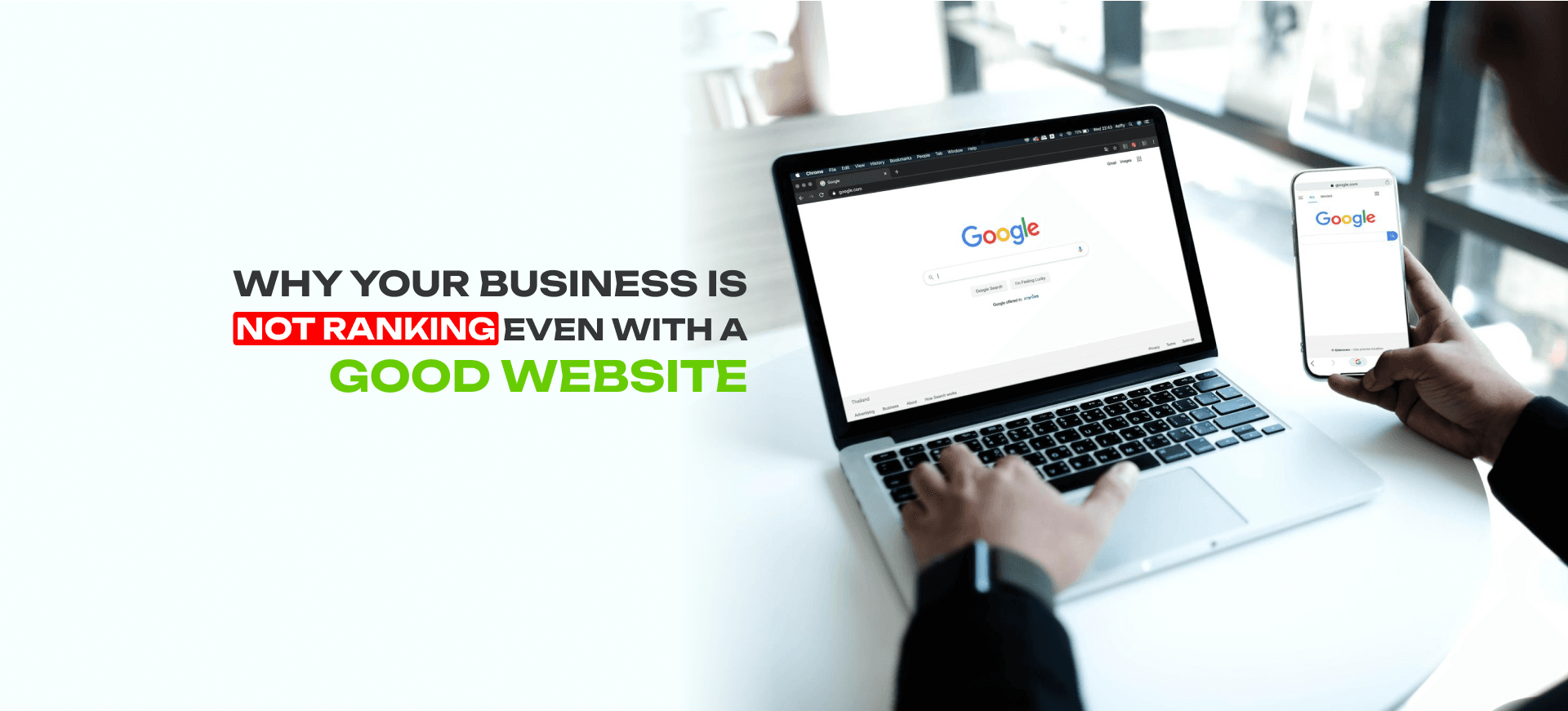

Why Your Business Is Not Ranking Even With a Good Website

Why Your Business Is Not Ranking Even With a Good Website

A website can look polished and still fail to bring in search traffic. The real problem is often not design, but the missing SEO work behind it.

HTSOL Inc

HTSOL Inc

published date

03, May 2026

#Content SEO

#Local SEO

#lead generation

Many business owners think that once they have a good website, Google rankings will follow. It sounds fair. You spend time and money on design, content, images, and branding. The site looks clean, modern, and professional. But after launch, nothing much happens. Traffic stays low. Calls do not increase. Leads do not improve. Your competitors still appear above you.

This is a common problem.

The truth is simple. A good website does not always mean a website that can rank well. A website can look great to people and still give Google very little reason to place it high in search results.

That is because ranking is not only about looks. It is about how useful your site is, how clear your pages are, how fast your site loads, and how well your content matches what people are searching for. It is also about trust. Google wants to show pages that answer real questions and help real people.

So if your business is not ranking, it does not always mean your website is bad. It may mean your website is missing the things that search engines need. At HTSOL, we often see businesses with strong-looking websites that still struggle because the SEO basics were never built in the right way.

Let us look at the real reasons this happens and what you can do to fix it.

A Good Website and a Search-Friendly Website Are Not the Same

A website can be beautiful and still not perform well in search.

Many websites are built to impress visitors. That is important. Good design helps people trust your brand. It makes your business look serious and polished. But design alone does not help much if search engines cannot clearly understand your pages.

Google does not rank a page because it has nice colors, clean sections, or smooth animation. It ranks a page because the page is useful, clear, relevant, and easy to understand.

That means your site may still not rank if:

  • your pages are too short

  • your keywords are too broad

  • your content does not answer user questions

  • your site is slow on mobile

  • your service pages are weak

  • your structure is confusing

  • your local SEO is missing

  • your site has little trust around it

A good website should do two jobs at the same time. It should look professional for people and make sense for search engines.

If one side is missing, your rankings can stay stuck.

Your Website May Not Match What People Are Searching For

One big reason websites do not rank is because they do not match search intent.

Search intent means the reason behind a search. When a person types something into Google, they want a certain type of result. If your page does not match that need, it has a lower chance of ranking.

For example, if someone searches for a service in their city, they usually want a page that is local, clear, and direct. If they search for advice, they want helpful content, not a hard sales pitch. If they search for pricing, they want simple details, not vague statements.

Many business websites miss this.

They create one home page and expect it to rank for many services. Or they write broad copy that sounds nice but says very little. Some sites speak too much about the business and not enough about the customer’s problem.

This creates a gap.

Your page may look good, but if it does not answer what the visitor wants, Google may choose another page that does.

Common signs of poor search intent match

  • a page tries to cover too many topics at once

  • a service page is too general

  • the content talks in a vague way

  • the page does not answer real customer questions

  • the main keyword does not match the page topic

A strong page should have a clear purpose. It should answer one main need and guide the user toward the next step.

If your website looks polished but still does not bring the right traffic, the issue may be page intent, not design. A proper SEO review can show what your pages are missing.

Your Content May Be Too Short, Too Broad, or Too Weak

Content is one of the biggest reasons websites fail to rank.

Some businesses build a nice website with just a few lines of text on each page. The pages look neat, but they do not explain enough. Search engines need clear content to understand what your page is about and who it is for.

If your service page has only one short paragraph, it may not be enough.

If your content uses only broad statements like “we offer quality service” or “we care about our clients,” that may sound fine, but it does not help much in search. These lines do not explain what you do, how you help, where you work, or why someone should choose you.

Weak content often looks like this

  • short service pages with little detail

  • copy that sounds nice but says very little

  • the same text style on every page

  • no local details

  • no customer-focused questions or answers

  • no proof, examples, or useful depth

Strong content does more

A strong page usually:

  • explains the service clearly

  • answers common customer questions

  • includes the right keyword naturally

  • shows who the service is for

  • makes the next step easy

Let us say you offer web design. A weak page may say you build modern websites. A stronger page may explain what type of websites you build, who you build them for, what problems you solve, what features matter, and why performance matters for growth.

That difference matters.

Google wants to rank pages that are useful. If your content is thin, your page may not be seen as useful enough.

Your Website May Have Technical Problems You Cannot See

Sometimes the problem is not content or design. Sometimes the issue is technical.

This is common because many technical SEO issues stay hidden. A business owner may visit the site and think everything looks fine. But behind the scenes, search engines may be facing problems.

Common technical issues that hurt rankings

Slow loading speed

If your pages take too long to load, users may leave before they even read anything. Slow speed also sends a bad quality signal. Heavy images, large scripts, and poor setup often cause this.

Poor mobile experience

Most people now visit websites on phones. If your site is hard to use on mobile, it can hurt rankings and user trust. Text may look too small, buttons may be too close, or the layout may feel broken.

Missing page titles and descriptions

Each important page should have a clear title and meta description. If these are missing or weak, your page may be harder to understand in search.

Weak heading structure

Your page should have one clear main heading and well-organized subheadings. This helps readers scan the page and helps Google understand the content.

Broken links and crawl issues

If some pages cannot be reached properly, or if links are broken, Google may not crawl your website well.

Pages not being indexed

In some cases, your pages may not even be indexed. That means they are not fully added to Google’s search system. If a page is not indexed, it cannot rank.

A website can look perfect on the front and still have hidden problems underneath. That is why technical checks matter.

You May Be Using the Wrong Keywords

A lot of businesses try to rank for the wrong words.

Some choose keywords that are too broad. Others choose words that real customers are not using. Some businesses try to target high competition terms even when their website is still growing.

This makes ranking much harder.

For example, a small company may try to rank for a huge term like “digital marketing” when a more realistic term would be “digital marketing agency for small business” or a city-based keyword linked to its service.

Good keyword choices are usually

  • clear

  • relevant to your service

  • realistic for your business size

  • tied to buyer need

  • linked to your city or niche if needed

Keyword choice should match the page purpose. It should also match how your customers search.

If your keyword strategy is weak, your content may never reach the right audience even if the writing is good.

Your Site May Not Have Enough Trust Signals

Google wants to rank businesses it can trust.

People want the same thing. If a person lands on your website and cannot quickly see who you are, what you do, where you work, and why they should trust you, they may leave. Search engines notice that kind of behavior too.

Trust signals help both users and Google feel more confident.

Important trust signals include

  • client reviews

  • testimonials

  • case studies

  • clear contact details

  • service area details

  • business location

  • secure website setup

  • team or company information

  • real project examples

A lot of business websites forget this. They focus on design but leave out the things that make the brand feel real and active.

If your site has little proof, weak contact details, and no signs of real work, it may struggle to compete with stronger sites in the same space.

A beautiful website should also build trust, support SEO, and bring leads. If it is not doing that, it may be time to improve the strategy behind it.

Your Local SEO May Be Missing

If your business serves a city, region, or local market, local SEO matters a lot.

This is one of the most missed areas on many websites.

You may have a good service page, but if it does not mention your service areas, local intent, or place-based terms, it may not show up well in local search.

Local SEO issues often include

  • no location pages

  • weak city-based keywords

  • missing Google Business Profile work

  • poor review activity

  • no local content

  • unclear name, address, or phone details

  • no local relevance on service pages

For example, if you serve one city or several nearby areas, your site should make that clear. If Google cannot see strong local signals, it may show a competitor instead.

This is very important for businesses such as:

  • clinics

  • agencies

  • legal firms

  • contractors

  • service providers

  • local shops

  • home service companies

A good-looking site with weak local SEO often stays invisible in local search.

Your Website May Not Have Enough Helpful Content Around Your Services

Many businesses only build core pages like Home, About, Services, and Contact. That is a good base, but it is often not enough for long-term growth in search.

Helpful content supports rankings.

This can include blog posts, guides, answer pages, and service support content. These pages help your website show up for more searches, especially the detailed questions people ask before they are ready to buy.

For example, a business offering web services can write about website speed, SEO basics, redesign mistakes, or how to choose the right platform. This builds traffic and trust over time.

Helpful content can support your site by

  • bringing new visitors from search

  • answering common client questions

  • building trust before a sales call

  • creating internal linking chances

  • helping your site cover more topics

This does not mean posting content just for the sake of posting. It means creating useful pages that solve real problems.

A strong content plan supports both SEO and lead generation.

Your Website May Be Designed More for Looks Than for Clarity

This happens often.

A business wants a clean, premium-looking site. The designer creates a very modern layout with lots of space, large images, sliders, and effects. The site looks impressive at first glance. But the content becomes hard to read. Important text is hidden. Key pages are too short. Some sections are placed inside tabs, sliders, or image blocks that search engines may not value as much.

That creates a problem.

A website should not only look nice. It should also be clear. Users should quickly understand what you do, who you help, and what action they should take next.

Signs that design may be hurting performance

  • too much text placed inside images

  • large banners but little useful content

  • important information hidden in sliders

  • heavy effects slowing down the page

  • low contrast that makes reading harder

  • style given more value than clarity

Good design should support the message, not block it.

At HTSOL, this is often where strong design and smart digital planning need to work together. A website should look good, but it should also help users move, read, trust, and act.

What You Should Fix First

If your website is not ranking, do not start by changing everything. Start by fixing the most important areas first.

Focus on these steps

1. Review your page purpose

Make sure each page has one clear goal and targets one main topic.

2. Improve your service pages

Add more useful detail, stronger headings, and clearer answers.

3. Fix keyword targeting

Choose phrases that match your services, audience, and market.

4. Check your technical setup

Improve speed, mobile layout, page titles, headings, and index status.

5. Add trust signals

Use reviews, work samples, contact details, and business proof.

6. Strengthen local SEO

Add location support if you serve local customers.

7. Build supporting content

Create blog posts and useful pages that answer real customer questions.

8. Improve internal linking

Connect related pages so users and search engines can move through the site better.

These steps help build a strong base. Ranking usually improves when the basics are handled well and the website is built around user need.

If your website is not ranking, the answer is rarely just “do more SEO.” The right step is to find the real weak points and fix them in the right order.

Conclusion

A good website is important, but it is only one piece of the puzzle.

Your business may have a clean design, strong branding, and solid services, yet still not rank because the search basics were missed. The problem may be weak content, poor keyword choices, slow speed, missing trust signals, or a lack of local SEO.

The good news is that these issues can be fixed.

When your website becomes clear, useful, fast, and focused on real user needs, it has a much better chance to rank well and bring the right leads. A website should not only look good. It should also work hard for your business.

That is when real growth starts.

HTSOL Inc

HTSOL Inc

HTSOL Inc. – Your Trusted Canadian Digital Marketing & Web Development Partner

Published on 03, May 2026

FREQUENTLY ASKED QUESTIONS

Providing answers to your questions

insta

view more on instagram

Instagram post 1
Instagram post 2
Instagram post 3
Instagram post 4