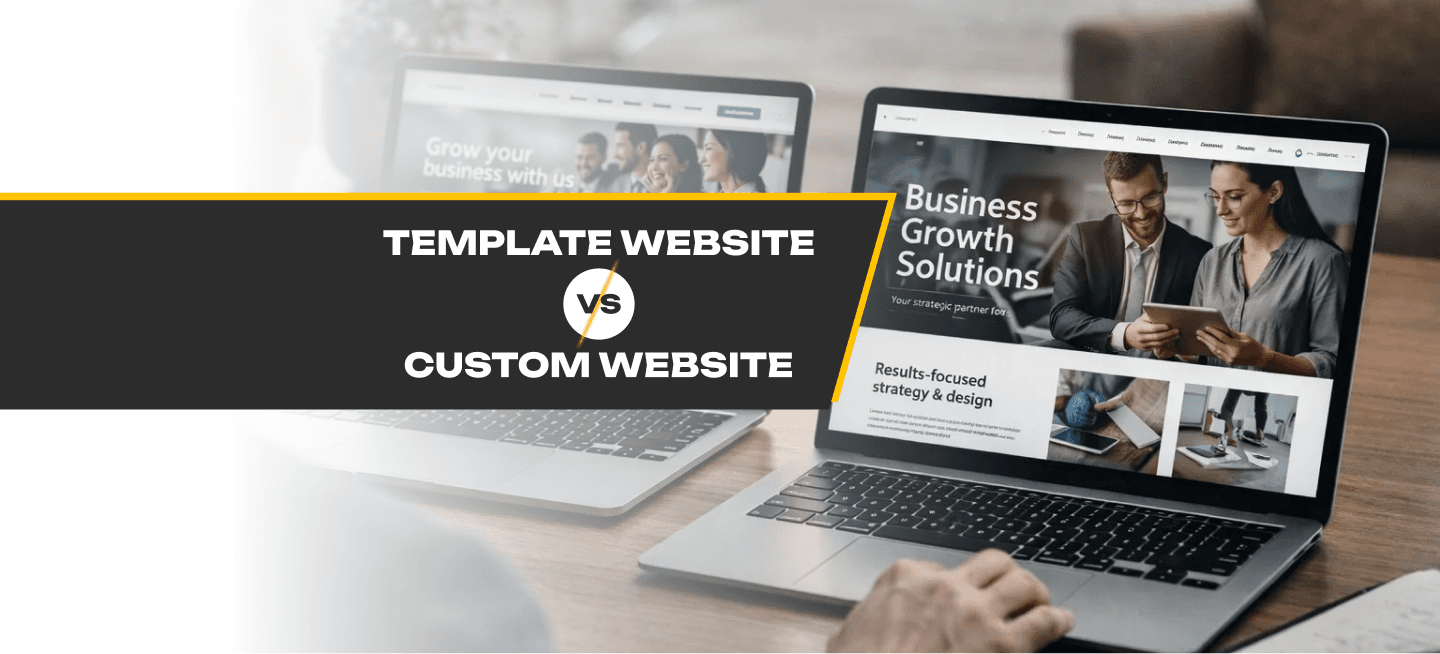

Template Website vs Custom Website for Growing Businesses

Template Website vs Custom Website for Growing Businesses

Both options can work, but they do not serve the same stage of business. The right choice depends on your goals, budget, and how fast you plan to grow.

HTSOL Inc

HTSOL Inc

published date

11, May 2026

When a business decides to build or redesign a website, one question comes up very quickly. Should you choose a template website or invest in a custom website?

At first, a template website can look like the easy choice. It is faster, lower in cost, and simpler to launch. For many small businesses, that can be a smart first step.

A custom website, though, gives you more control. It is built around your brand, your goals, and the way your customers move through your site. It usually costs more, but it can support stronger growth over time.

The problem is that many growing businesses choose based on price alone. They do not think about where the business will be six months from now, one year from now, or two years from now. That is where mistakes happen.

A website is not just something your business has online. It is part of how people find you, trust you, and decide whether to contact you. It should support your next stage of growth, not hold you back when things start moving.

In this guide, we will break down the real difference between template and custom websites, the pros and cons of each, and how to choose the right one for a growing business.


What Is a Template Website?

A template website is built from a ready-made design. Instead of starting from scratch, you choose a layout that already exists and then change the text, images, colors, and some sections to match your brand.

This is a common option on many website platforms and is often used by:

  • startups

  • solo business owners

  • small local businesses

  • businesses with a small budget

  • Companies that need a site to live quickly

Template websites are popular because they are simple. You do not need to build every part from zero. The main layout is already done for you.

Why do businesses choose template websites?

Businesses often choose templates because they offer:

  • lower upfront cost

  • faster launch time

  • simple setup

  • less planning work at the start

  • An easy way to get online

For a business that only needs a basic online presence, a template website can do the job well.

But the key point is this: a template helps you start fast, not always grow well.

What Is a Custom Website?

A custom website is built around your business from the ground up. The design, page structure, user flow, and features are made to fit your brand and your goals.

Instead of adjusting your business to match a pre-made layout, a custom website is built to match your business.

This makes it a stronger option for companies that need:

  • a unique brand look

  • better lead generation

  • more control over content flow

  • special features

  • better room for growth

  • a stronger search presence

A custom website usually takes more time and costs more than a template site. But it also gives you more freedom and fewer limits later.

That is why many growing businesses move to a custom site when their simple website no longer supports their sales, marketing, or service needs.

The Main Difference Is Flexibility

The biggest difference between a template website and a custom website is flexibility.

A template gives you a set frame. You can adjust parts of it, but you still work inside the limits of that design.

A custom website gives you freedom. You can shape each page around your message, your audience, and your business goals.

This difference matters more as your business grows.

A small business with simple needs may not feel the limits of a template right away. But once you want better landing pages, more service pages, stronger lead flow, or a different user path, those limits can start to show.

Simple way to think about it

A template website is like renting a furnished space. It is quick and useful, but you cannot change everything.

A custom website is like building a space around the way you actually work. It takes more effort, but it fits better.

That fit can make a big difference when your business is trying to grow.

When a Template Website Makes Sense

Template websites are not bad. In many cases, they are the right choice.

If your business is still early, your offer is simple, and your budget is tight, a template website may be the best step right now.

A template website is a good fit when

  • You need to launch quickly

  • Your budget is limited

  • You only need a few pages

  • Your site does not need special tools

  • Your business is still testing its offer

  • You mainly need a clean online presence

For example, if you are a new local service provider and just need a home page, about page, service page, and contact page, a template site can work well.

It can also help you avoid spending too much too early. That matters for businesses that are still finding their market.

The benefits of a template website

Lower cost

This is usually the biggest reason businesses choose a template site.

Faster launch

Since the layout already exists, the website can go live sooner.

Easier to manage

Many template websites are built on simple systems that make small updates easier.

Good for basic needs

If your business does not need custom pages or special features, a template may cover the basics well.

When a Template Website Starts Holding You Back

A template works best when your business needs are simple. The problem starts when your business is no longer simple.

As you grow, your website often needs to do more than just exist online. It may need to bring leads, explain more services, support paid ads, rank better in search, or guide people through a stronger buying path.

That is where many businesses begin to feel stuck.

Common limits of template websites

Your site may look like many others

Because templates are shared designs, your website may feel less unique. Even after changing colors and images, the layout may still look familiar.

You may have layout limits

Sometimes you want to place content in a certain way, but the template does not allow it without major work.

Growth can become messy

As new pages, services, and offers are added, the website may start to feel forced instead of planned.

Search performance can suffer

If the structure is weak or the page flow is too generic, it can be harder to build strong content around search goals.

Special features may be hard to add

Booking tools, member areas, advanced forms, or custom service flows may not fit well into a template setup.

A template website can be a good start. It just may not be the best long-term system for a growing business.

When a Custom Website Makes Sense

A custom website becomes a stronger choice when your business is trying to move from basic presence to real online growth.

This is often the stage where your website needs to support sales, build trust faster, and help customers take action.

A custom website is a good fit when

  • Your business is growing fast

  • Your services are becoming more detailed

  • Your website needs to generate leads

  • You want a stronger brand image

  • You need a better user journey

  • Your current site feels limiting

  • You plan to invest in SEO or digital marketing

  • You want room to scale without rebuilding soon

This is where custom work starts to show its value.

A custom website is not just about making things look nicer. It is about building a website that works the way your business needs it to work.

Why Growing Businesses Often Outgrow Templates

Growth changes what your website needs to do.

At the start, your website may only need to explain what you offer. But as the business grows, the website often needs to help with many more things:

  • better search traffic

  • more location pages

  • stronger service pages

  • paid ad landing pages

  • better call-to-action flow

  • customer trust

  • easier content updates

  • Team use and future expansion

A template site can struggle with this because it was not planned around your full growth path.

A custom website is better at handling change because the structure is planned with purpose. Pages are built around goals. Sections are designed to lead users clearly. Your message is placed where it matters most.

For growing businesses, that structure can help turn a website from a simple online brochure into a real business tool.

Design Is Not the Only Issue

Many people think the template vs custom question is only about appearance. It is not.

Yes, design matters. A custom site can give you a more unique look. But the deeper issue is how the website works.

A website should support business goals

Your website should help with things like:

  • getting more calls

  • improving form submissions

  • building trust quickly

  • showing your services clearly

  • supporting search rankings

  • helping people move through the site with ease

If your website looks fine but does not help with these goals, then the problem is not only design.

A custom website gives you more control over these parts. That is why it often works better for businesses that are serious about growth.

Which One Is Better for SEO?

If your business cares about getting traffic from Google, this question matters a lot.

A template website can rank well if it is built carefully, has strong content, and follows a good structure. So no, templates do not automatically fail at SEO.

But a custom website usually gives you more control over the things that support search growth.

Why do custom websites often support SEO better

  • The page structure can be planned more clearly

  • Service pages can be shaped around real search needs

  • Internal linking can be built with a purpose

  • Content sections can be placed where they help most

  • Page speed and mobile layout can be improved more freely

  • Growth pages can be added more cleanly later

For a small business with basic goals, a template may still do enough. But for a growing business that wants stronger search traffic over time, a custom site often gives better long-term support.

This is one reason many brands that invest in SEO later move away from templates.

Which One Is Better for Branding?

Branding is more than a logo and colors. It is the full feeling people get when they visit your website.

A template can still look professional, but it may not fully express what makes your business different.

A custom website gives you a better chance to shape that experience.

With a custom website, you can

  • Build pages around your voice

  • Guide users in a more natural way

  • Highlight key services better

  • Make your offer stand out

  • Create a stronger first impression

For growing businesses, this matters because stronger branding can support trust, pricing, and conversion.

If your website looks too similar to other businesses in your space, it becomes harder to stand out.

Cost: Short-Term Savings vs Long-Term Value

Templates usually cost less at the start. Custom websites usually cost more.

That part is clear.

But the better question is not only what the website costs now. The better question is what it helps you do later.

A template may save money today, but if you rebuild in a year because the site no longer fits your business, the short-term savings may disappear.

A custom website may cost more now, but it can reduce the need for major changes later.

Think of cost in two ways

Upfront cost

Template websites usually win here.

Long-term value

Custom websites often win here, especially for businesses planning to grow.

This does not mean every business should choose custom. It means the right decision should match your stage, your goals, and your next move.

Questions Growing Businesses Should Ask Before Choosing

Before you choose between a template and a custom website, ask these questions:

1. What does our website need to do in the next 12 months?

If the answer is “just be online,” a template may be enough. If the answer includes traffic, leads, stronger pages, and better conversion, custom may be better.

2. Are we still testing our offer?

If yes, a template may be a smart first step.

3. Do we need special pages or features?

If yes, a custom website may save time and stress later.

4. Do we plan to grow our marketing?

If you plan to invest in SEO, paid ads, or content marketing, a stronger website structure matters.

5. Will this website still fit when the business grows?

This is one of the most important questions of all.

The goal is not to buy the biggest website. The goal is to choose the website that fits your stage and supports where you are heading next.

A Smart Middle Ground

Not every decision has to be extreme.

Some growing businesses do best with a staged approach. They start with a clean and simple website, then move into more custom work as the business grows.

This can be a smart path if you want to control costs while still planning ahead.

For example, you may start with:

  • A focused website with core pages

  • Clear brand structure

  • Strong content planning

  • Room to add better landing pages later

Then, as the business grows, you can move into deeper custom work with more confidence.

At HTSOL, this kind of planning matters because the best website is not always the biggest one. It is the one that makes sense for your business now and still supports what comes next.

Conclusion

So, template website or custom website for a growing business?

The answer depends on your stage.

A template website is a strong option when you need speed, simplicity, and lower cost. It can help you launch fast and build a basic online presence without a big investment.

A custom website is the better option when your business needs more control, stronger branding, better lead flow, and room to grow. It takes more time and budget, but it can support your business more fully over the long term.

The key is to stop thinking only about today. A growing business needs a website that supports the next stage, not just the current one.

If your website is starting to feel limited, hard to expand, or too generic for your brand, it may be time to move beyond a template. HTSOL helps businesses choose the right website path based on growth goals, not just launch speed.

HTSOL Inc

HTSOL Inc

HTSOL Inc. – Your Trusted Canadian Digital Marketing & Web Development Partner

Published on 11, May 2026

FREQUENTLY ASKED QUESTIONS

Providing answers to your questions

insta

view more on instagram

Instagram post 1
Instagram post 2
Instagram post 3
Instagram post 4